
Tokens & deployments
The lifecycle of a deployment token: minting, rotating, and the rule that keeps two clusters from sharing one identity.
A deployment token is the entire identity of an operator instance. There's no per-resource scoping and no role bundle. The token grants one right: to be the deployment it was minted for. User authorisation lives in the control plane, where the permission catalog can evolve, not on a string sealed into a Secret.
What's in a token
A deployment token is an opaque, prefixed string. The prefix lets support and log scrubbers identify the token type without revealing the secret half.
1exo_dpl_8a4b9f3e2d1c0a7b6e5f4d3c2b1a09f82 │ └────────────────────────────── opaque entropy (16 random bytes, 32 hex chars)3 └────────────────────────────────────── product + type prefix ("exo_dpl_" = deployment)We persist sha256(token) plus the visible prefix, never the raw secret. A leaked token can't be recovered from the database, only rotated away.
Minting a token
Tokens are minted from Deployments → New in the dashboard. The token is shown exactly once on the creation screen. After that the dashboard shows only the prefix and the issuance timestamp. The secret half is unrecoverable.
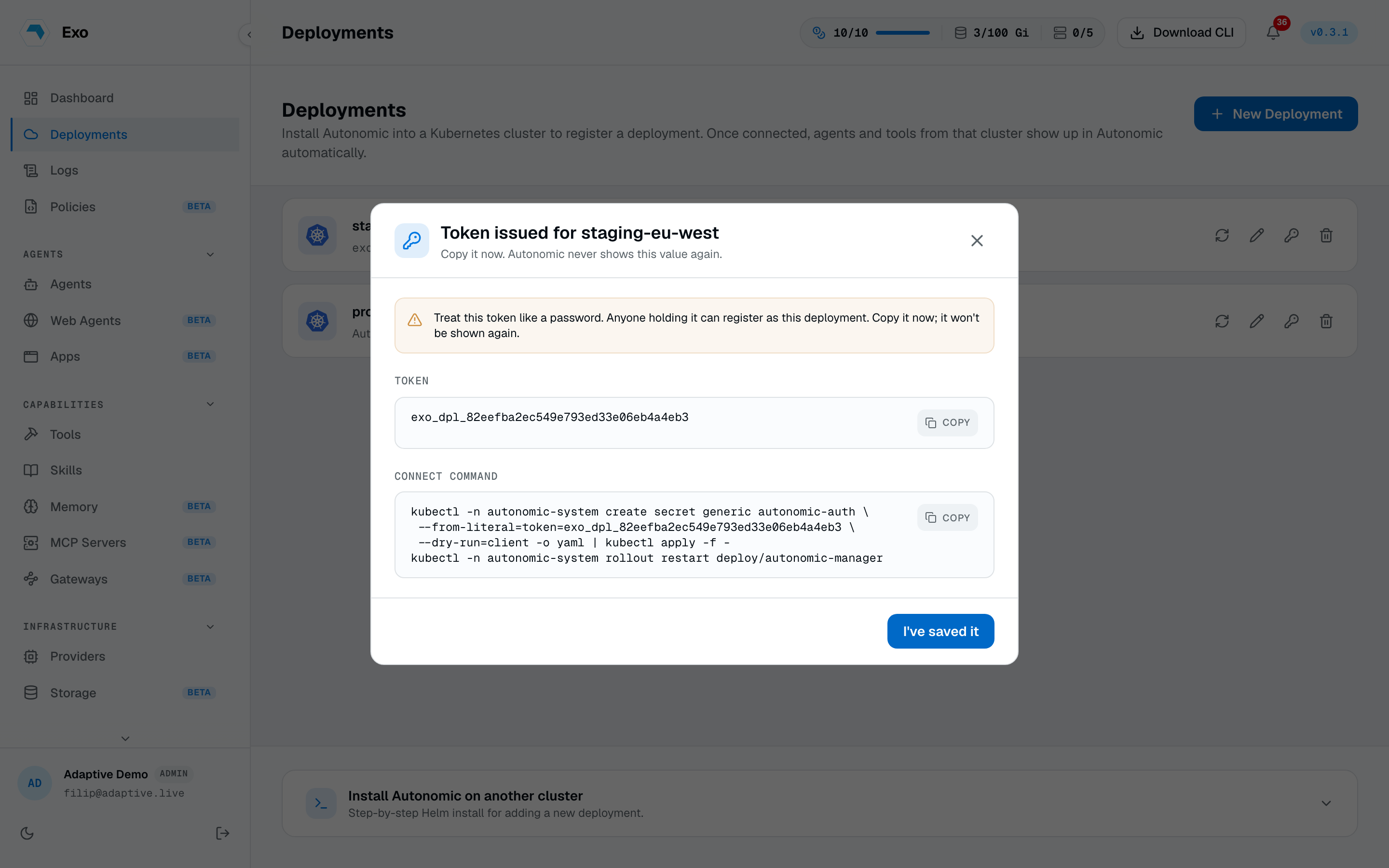
Rotation
Mint, deploy, and let the old token expire.
- Mint. Click Rotate on the deployment row. Copy the new token from the modal.
- Deploy. Update the
AUTONOMIC_AUTH_TOKENSecret. The pod's environment refreshes on next restart, so trigger a rollout or let your secret-reloader handle it. - Let it land. The new connection presents the new token; the old token is rejected on its next reconnect attempt.
Deployment tokens have no overlap window. The control plane enforces one active connection per deployment, so you can't run the old and new connections at once. The reconnect is fast, and the dashboard shows one deployment, not two competing identities.
Revocation
Revocation is rotation without a successor. Click Revoke on the deployment row. The token's hash is removed from the database, the active connection is closed, and the operator's next handshake is rejected.
One-to-one binding
A token binds 1:1 to a deployment. The control plane rejects a second active connection presenting the same token, using a last-writer-wins grace window. This means three things.
- You can't share a token across clusters. Multi-cluster tenants mint one token per cluster. Each cluster gets its own dashboard identity, audit trail, and rotation cadence.
- Leader election needs no extra config. Replicas of one deployment compete for the single connection slot. Whoever holds the lease holds the connection.
- Disaster recovery is rotation. When the primary cluster comes back, rotating the token hands ownership to the new replica.