
Exo docs
Run AI agents on your own infrastructure. Build an agent, that connect with your databases, cloud, VMs, clusters through tunnelled connections, put every tool call under policy, and replay any session. Your agents, compute and data stay in your cluster.
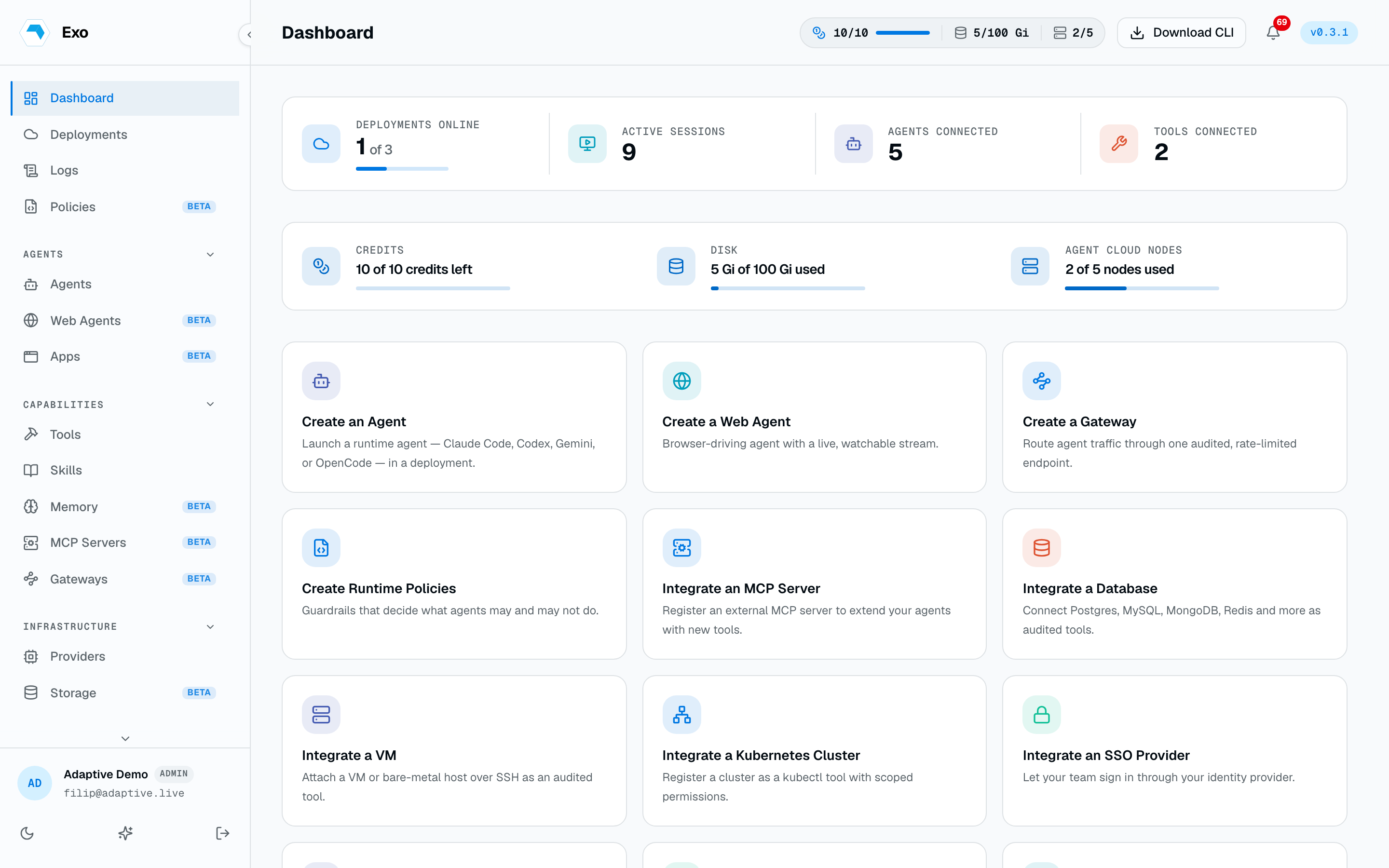
What you can do
Exo is a control plane for agents that run in your own Kubernetes.
New here? Start with Concepts & vocabulary, then create your first agent.
Architecture
A declarative control loop: CRDs define desired state, the operator reconciles them into Kubernetes primitives, and telemetry streams back to the control plane.
Two components make that work. The control plane (stateless backend, embedded UI, Postgres) serves the dashboard and API. The Exo Operator and the CRDs install into each workload cluster and turn Agent and Tool objects into running pods, with one outbound connections as the only link back. The full story (components, data flows, topologies) is in Architecture.
Audience
- Agent builders. Define agents, give them tools, then wrap them in governance. Sections 02 to 03.
- End users. Connect to an agent, reach your systems, and replay what happened. Sections 04 to 05.
- Admins and operators. Bind an IdP and define roles, then deploy and run the control plane and operator. Sections 06 to 08.